
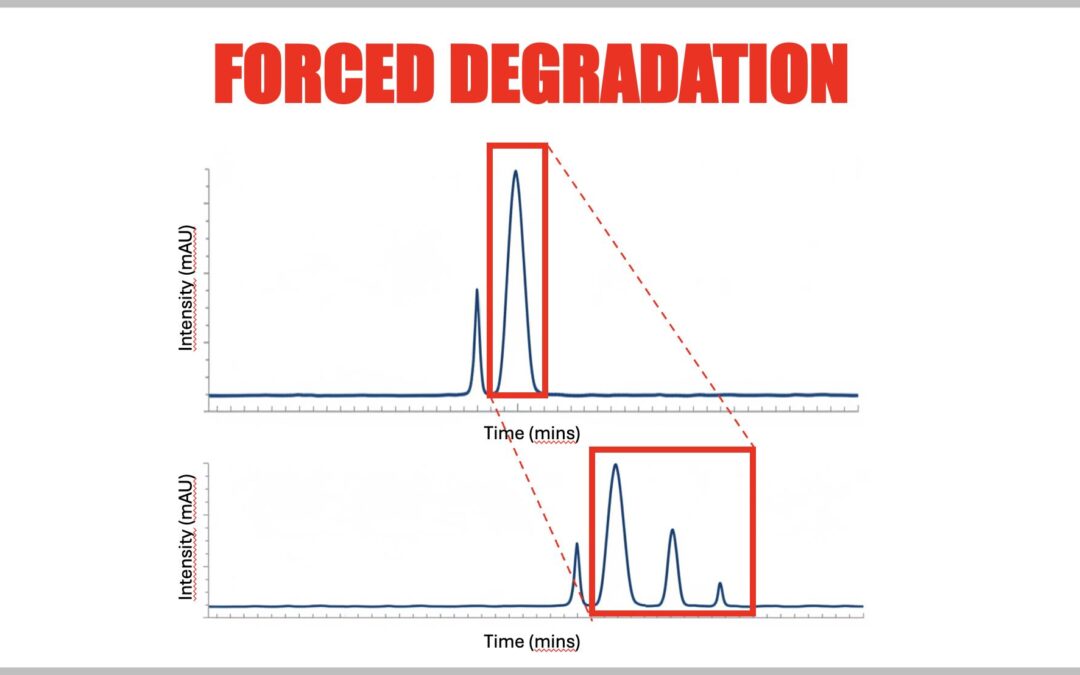
Forced degradation in HPLC, also known as stress testing, is a key component of HPLC method development in pharmaceutical analysis. In this process, an active pharmaceutical ingredient (API) is deliberately exposed to stress conditions such as acid, base, oxidation, elevated temperature, humidity, or light to generate relevant degradation products. The aim of the test is to separate the API from degradation products and other impurities. Consequently, forced degradation studies provide a crucial foundation for developing and validating highly specific HPLC methods. The objective is to obtain a controlled and representative degradation profile rather than complete decomposition. Peak purity is determined using DAD or PDA detectors, while orthogonal methods such as LC-MS provide additional information regarding peak purity and potential co-elution.
Contents
I had developed and optimized an HPLC method for a client. I was pleased with the result: the main peak was sharp, symmetrical, and cleanly separated from impurities, a textbook example of an HPLC method.
However, as the project progressed, it became clear that this initially perfect result was insufficient. Additional peaks appeared as the active pharmaceutical ingredient (API) aged. This shifted the key question regarding the method: Were other peaks hidden beneath the API peak? And could I truly assume that my main peak was pure?
Typically, degradation of the active ingredient is not detected in the laboratory until much later—usually after method validation. This often occurs during stability studies, six to twelve months into storage. Such delays consume valuable time, effort, and money.
The regulatory context is also clear: stress testing is intended to help identify likely degradation products, understand degradation pathways and API stability, and assess the suitability of a stability-indicating analytical method [ICH Q1A(R2)].
For this reason, I perform forced degradation studies on the sample during method development to detect potential degradation products at an early stage. This is a crucial aspect of demonstrating specificity—both during method development and subsequent validation—particularly for active pharmaceutical ingredients.
What is forced degradation in HPLC?
In a forced degradation study, an active pharmaceutical ingredient or drug product is deliberately exposed to harsh conditions. The goal is to induce controlled degradation—for instance, through the use of acids, bases, oxidizing agents, elevated temperatures, humidity, or light [Blessy 2013]. Often, reference standards for the degradation products are not available at the start of the project; consequently, the forced degradation study provides me with a “worst-case” impurity profile to guide method development.
The objective is not to destroy the active ingredient completely. Rather, the aim is to generate a degradation profile that is analytically meaningful. For me, a forced-degradation sample represents a realistic challenge for the HPLC method intended for subsequent use in stability studies.
Forced degradation is distinct from a standard stability study. A stability study evaluates actual stability under specific storage conditions, whereas forced degradation deliberately induces potential degradation pathways within a short timeframe by using harsh conditions.
Why is a forced degradation study conducted in HPLC?
1. Understanding degradation pathways and degradation products
Forced degradation studies provide important insights into the potential degradation products of the active substance before a stability study is conducted. This rapid study helps me understand the degradation pathway and products, as well as whether the active substance is particularly sensitive to water, oxygen, heat, or light. This information helps identify potential critical risks associated with HPLC analysis.
2. Develop a specific HPLC method
The primary analytical objective is to develop a robust and specific HPLC method. Such a method must be capable of reliably distinguishing the intact active pharmaceutical ingredient (API) from its degradation products, related substances, and other impurities. Furthermore, for use in subsequent stability studies, the method must be able to reliably detect potential degradation products arising from stressed samples with a high degree of specificity.
The FDA defines a stability-indicating method as a procedure that allows for the reliable determination of the active ingredient, degradation products, and other relevant components without interfering effects. [FDA] This is precisely where the practical significance of forced degradation lies for me: it helps to demonstrate whether an API peak is truly distinct or if a degradation product might be co-eluting within the same signal.
In particular, the method must:
- clearly separate the active ingredient from relevant degradation products,
- reveal critical peak overlaps,
- demonstrate sufficient resolution,
- capture changes in the degradation profile,
- enable reliable quantification of the active ingredient.
Forced degradation thus provides a challenging sample matrix that allows for a realistic assessment of the HPLC method’s performance.
3. Investigate the specificity of the HPLC method.
Specificity means that the method can unequivocally determine the analyte in the presence of other components. These include impurities and degradation products.
Important distinction:
> Selectivity: The ability of an HPLC method to cleanly separate two or more analytes (substances) from one another.
> Specificity: The ability of a method to unequivocally determine a specific analyte in the presence of other components (e.g., matrix, impurities).
An apparently pure active ingredient peak is not automatically a specific peak. If a degradation product elutes at the same retention time, the measured active ingredient content can be skewed. In that case, part of the signal no longer originates from the unchanged active ingredient. And even worse: a significant degradation product could be overlooked.
This is particularly critical for stability samples analyzed using a validated method. If a new degradation product co-elutes beneath the active ingredient peak, it distorts the stability study. The validation would then be rendered invalid.
A forced degradation study helps to identify such risks during method development and to develop the method optimally.
4. Ensure the subsequent method validation
A method should not be exposed to realistic degradation products for the first time during validation. If additional peaks or unexpected co-elutions appear at that stage, further method development may become necessary.
This results in additional time requirements, higher costs, and project delays. The situation becomes even more critical if stability data have already been generated using an unsuitable method.
Forced degradation studies conducted prior to validation can reveal whether, for example:
- the active ingredient and degradation products are not sufficiently separated,
- additional peaks overlap with the active ingredient peak,
- the method’s specificity and selectivity are inadequate,
- sample solutions are unstable during preparation and the HPLC run,
- or the method lacks sufficient sensitivity for relevant degradation products.
Consequently, stress testing reduces the risk of encountering surprises later during validation, stability studies, or routine analysis.
What a forced degradation study means for validation
A forced-degradation sample does not replace method validation, but it does provide a significantly better foundation. If I develop the method using stressed samples, I have a better understanding of where the critical separation lies and which degradation products need to be taken into account during validation.
In my view, this is time well spent. Adjusting the method during development is generally much easier than questioning a validated method later due to unexpected degradation products.
The most important point is that the forced-degradation study should not merely generate additional peaks; it should demonstrate that the method actually detects relevant degradation products.
To what extent should an active substance be degraded?
In practice, the aim is to achieve active substance degradation of 10% to 30%. However, this range should not be viewed as a rigid limit. Zelesky et al. point out that both excessive and insufficient stressing can be problematic. Conditions that are too harsh can produce an unrealistic degradation pathways and lead to an overly complex method. Conversely, if the stress applied is insufficient, potential degradation products that might appear later during formal stability studies could be overlooked. [Zelesky 2023]
Controlled and scientifically justified degradation is crucial. Stress conditions should be severe enough to generate relevant degradation products and challenge the HPLC method. At the same time, conditions should be selected to avoid the formation of secondary or unrealistic degradation products or the complete destruction of the active substance.
The goal is a representative degradation profile that:
- reveals the relevant degradation pathways,
- sufficiently challenges the analytical method,
- detects potential co-elutions,
- and enables a realistic assessment of stability.
Which stress conditions are being investigated?
For me, the choice of appropriate stress conditions always depends on the active ingredient and the specific question at hand. There is no single standard condition that yields the same information for every substance.
Different stress conditions often produce widely varying degradation profiles. This is analytically interesting because it reveals the separations the method actually needs to achieve. Excessively harsh degradation conditions can generate degradation products that might not be relevant under actual storage conditions.
Controlled degradation is important to me. I want to understand which additional peaks are formed, whether they elute near the active ingredient peak, and whether the method I have developed can resolve them.
Assess peak purity using DAD/PDA and an orthogonal method
The DAD or PDA detector provides valuable information regarding peak purity. This is important for assessing whether a peak is pure or if another peak is hidden beneath it. I compare the UV spectra at the peak front, apex, and tail. If the peak shows a comparable UV spectrum across its entire width, this indicates a homogeneous peak. If the UV spectra differ, this points to co-elution, as shown in Figure 1.
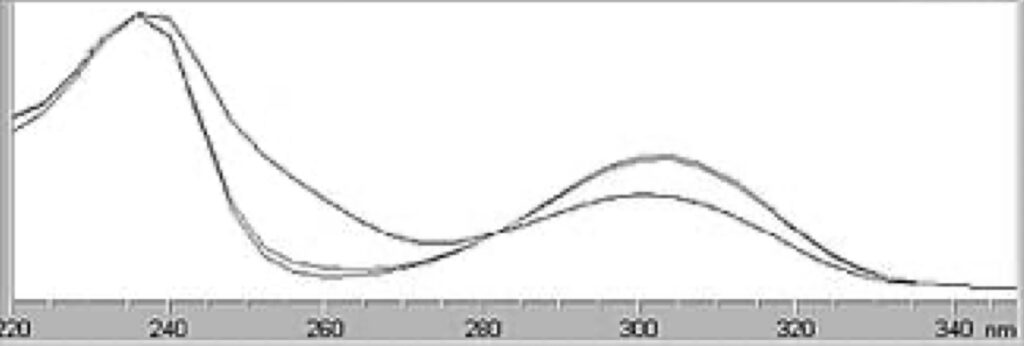
Comparable UV spectra suggest that the peak is pure, though this does not constitute definitive proof; two components can exhibit similar UV spectra. Furthermore, the spectrum is concentration-dependent: if the impurity level within the main peak is below 0.5–1%, it may not be visible in the spectrum.
I also like to use a fractionation approach: I collect the main peak using a fraction collector (separating the front, apex, and tail, if possible) and then re-run the fractions using the same method. If another peak is hidden beneath the main one, it should become visible.
Another option for the precise characterization of degradation products involves isolating the products generated during the forced degradation study via semi-preparative HPLC and analyzing them (using NMR, LC-MS, etc.). This yields reference substances for the respective degradation products, which can then be used for method development and validation.
Why an orthogonal method like LC-MS is helpful
To obtain a more precise assessment of peak purity, I recommend analyzing the peak using an orthogonal method. LC-MS analysis provides additional information regarding mass and potential identity.
The combination of HPLC, DAD/PDA, and the orthogonal LC-MS method gives me greater confidence in assessing peak purity. Critical impurities should be verified using characterized reference substances.
Forced degradation is not a substitute for a stability study
In project discussions, forced degradation is sometimes equated with stability studies. To me, however, they are two clearly distinct investigations. They do, after all, have different objectives:
| Forced Degradation | Standard Stability Study |
|---|---|
| Uses specifically harsher stress conditions. | Uses defined storage conditions |
| Untersucht mögliche Abbauwege | Assesses stability over time |
| Investigates possible degradation pathways | Provides data on shelf life and storage |
| Supports the development of the analytical method | Supports the evaluation of the medicinal product |
| Checks the separation of the active ingredient and degradation products. | Evaluates the actual product change |
Forced degradation studies reveal which degradation pathways are fundamentally possible and whether the HPLC method can detect the resulting degradation products. Stability studies, on the other hand, show how the product actually behaves over time (6–12 months) under predefined longer storage conditions.
Conclusion
My experience shows that forced degradation methods are irreplaceable for active ingredients and medicines. Because it shows whether the method can safely separate degradation products formed under harsher conditions.
Forced degradation helps to understand degradation pathways, visualize potential degradation products and develop a selective HPLC method. The stress test should be integrated into method development before method validation.
Anyone who uses forced degradation early and sensibly reduces the risk of hidden co-elutions, improves the validity of method validation, saves time and costs and creates a more reliable basis for later stability studies.
If you have any further questions regarding Forced Degradation in HPLC,
👉 Contact me without obligation →
Frequently Asked Questions (FAQ) about Forced Degradation in HPLC
What does forced degradation mean?
Forced degradation, referring also to a forced degradation,degradation study, stress study or stress test, is a process where an active drug substance (API) is deliberately exposed to stress conditions, such as acid, base, oxidation, elevated temperature, humidity, or light, in order to generate relevant degradation products more rapidly than in a stability study.
Why is forced degradation performed prior to method validation?
The study aims to demonstrate whether the HPLC method adequately separates the active ingredient, degradation products, and impurities from one another. This allows weaknesses to be identified and rectified before validation.
What level of degradation is appropriate for forced degradation studies?
A degradation of the active substance in the range of approximately 10 to 30 % is often cited as a practical guideline. However, the suitable range depends on the active substance, the stress conditions, and the objective of the study. There is no universally applicable value for every substance.
Can a DAD or PDA detector prove peak purity?
DAD and PDA detectors can provide important indications regarding peak purity. However, they do not rule out every possible co-elution. For critical peaks, orthogonal analysis, such as LC-MS, can provide additional evidence.
Is forced degradation the same as a stability study?
No. Forced degradation employs specifically intensified conditions to investigate potential degradation pathways and the performance of the analytical method. A stability study, on the other hand, evaluates the behavior of the drug product under defined storage conditions over a specific period.
Which HPLC method is suitable for forced degradation?
A suitable method is one capable of separating the active substance from relevant degradation products and impurities. The specific choice of column, mobile phase, gradient, detection, and sample preparation depends on the chemical properties of the active substance and the expected degradation profile.
References
- ICH Q1A(R2), Stability Testing of New Drug Substances and Products: EMA/CPMP/ICH/2736/99, gültig ab 01.08.2003
- Blessy et al., Development of forced degradation and stability indicating studies of drugs: A review, Journal of Pharmaceutical Analysis, 2014, DOI: 10.1016/j.jpha.2013.09.003
- FDA, Questions and Answers on Current Good Manufacturing Practice Requirements: Laboratory Controls. fda.gov/drugs (abgerufen am 11.010.2026)
- Zelesky et al., Pharmaceutical Forced Degradation (Stress Testing) Endpoints: A Scientific Rationale and Industry Perspective, Journal of Pharmaceutical Sciences, 2023, DOI: 10.1016/j.xphs.2023.09.003
- Agilent Application Note: Peak purity analysis in HPLC and CE using diode-array technology. Publication Number: 5988-8647EN. community.agilent.com
About the Author

Dominic Franck is an HPLC specialist with over 15 years of experience in the pharmaceutical and radiopharmaceutical industries and the founder of the HPLC Academy. He learned the radio-HPLC basics over 11 years ago at the University of Cambridge and ETH Zurich, where he further developed his knowledge and wrote a paper on the subject. He served as head of the Analytics Department and has overseen numerous HPLC validations and audits. On his YouTube channel, he provides practical guidance on using HPLC and shares tips and tricks for troubleshooting. Through the HPLC Academy and the specialized Radio-HPLC module, he helps users, analysts, and QC managers develop, optimize, and validate their methods on the first try and pass audits with confidence.
Many videos on the topic: Radio-HPLC detectors (German): YouTube
Connect with me: LinkedIn
Free HPLC knowledge base: HPLC-Academy
Last updated: October 2026