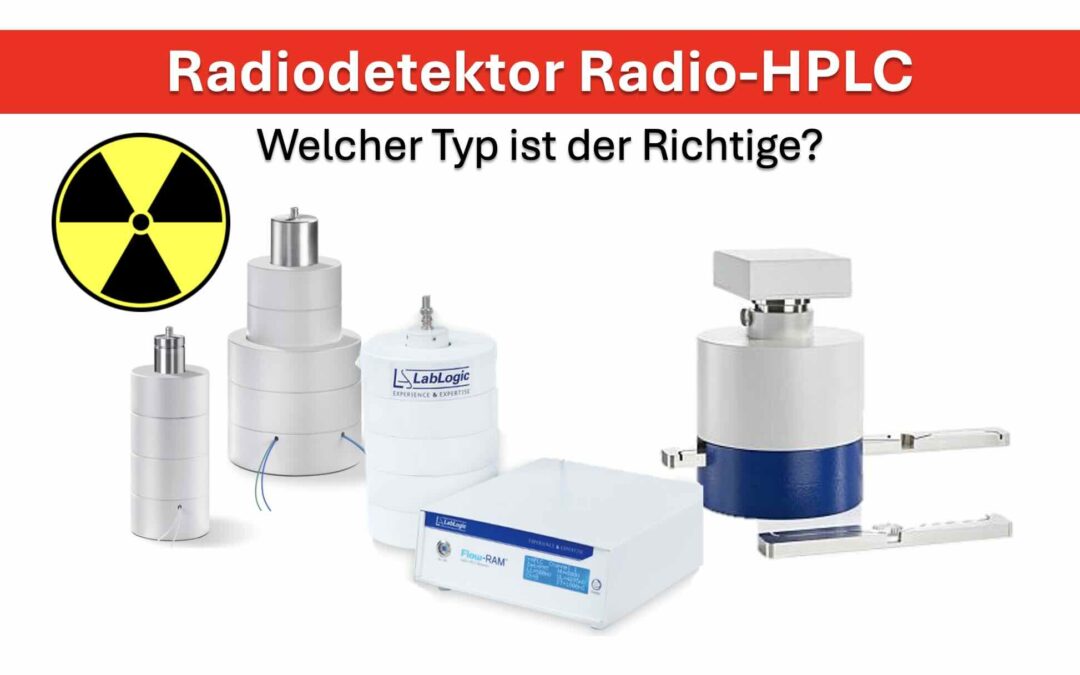
The radio-detector is the heart of any radio-HPLC system. At the same time, it is the component where most errors occur during system selection. There are four basic types of detectors: the NaI(Tl) gamma detector, the plastic scintillator beta detector, the coincidence detector, and the liquid scintillation detector. Each is suited to specific isotopes and applications. An incorrect choice leads to poor sensitivity, high background noise, or simply erroneous results.
Summary of the article on radio-detector radio-HPLC
- All radio-detectors operate based on the scintillation principle: radiation → light flash → electrical pulse → count rate
- NaI(Tl) is the most versatile detector, suitable for PET, SPECT, and gamma emitters such as ¹⁷⁷Lu
- Plastic scintillators are ideal for dedicated PET centers: compact, lead-free, and requiring no calibration
- Coincidence detectors offer the best signal-to-noise ratio for PET; an LOQ of less than 100 Bq is achievable
- Liquid scintillation is essential for alpha emitters, ³H, and ¹⁴C
- Alpha emitters (e.g., ²²⁵Ac) require fraction collection rather than direct in-line detection
- Measurement cell volume involves a critical trade-off: higher volume means greater sensitivity but reduced chromatographic resolution
Contents
- How does a radio-detector work: The scintillation principle
- Detector order is important
- An overview of the four types of radio-detectors
- Quick Decision: Which Radio-Detector for Which Situation?
- All 4 radio-detector types at a glance
- FAQ
- List of Sources
- Next Step
- About the Author
How does a radio-detector work? The scintillation principle
All radio-detectors in radio-HPLC are based on the same fundamental principle: scintillation.
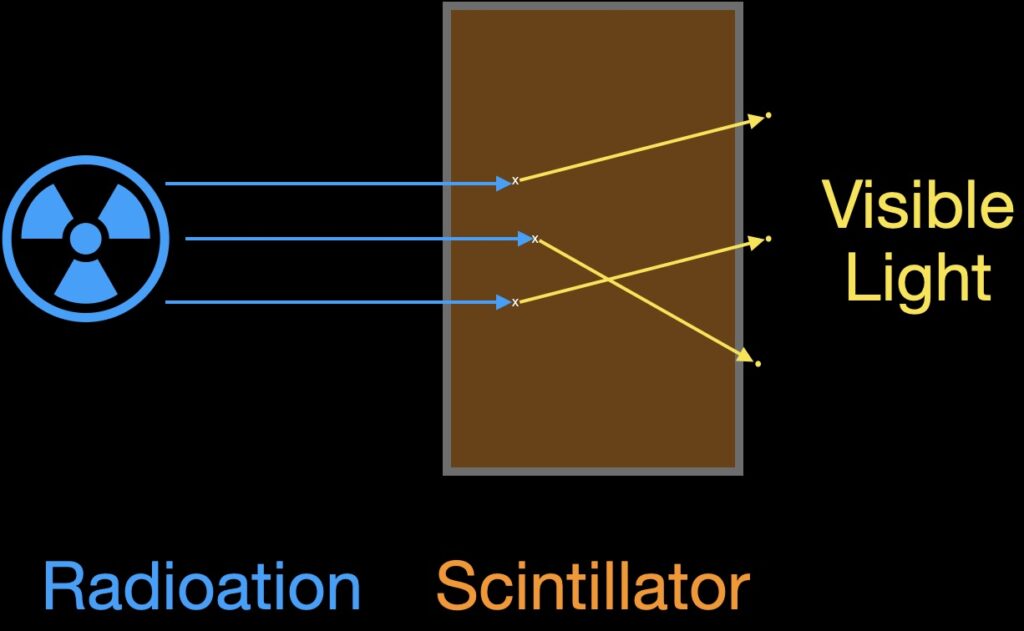
When ionizing radiation interacts with a scintillator material, it deposits energy and stimulates the material to emit a brief flash of light. This light flash is converted into an electrical pulse by a photomultiplier (PMT) or a modern silicon photomultiplier (SiPM). The number of pulses per unit of time yields the count rate. The count rate is proportional to the radioactivity in the measurement cell.
Detector order is important
An often overlooked but critical error in radio-HPLC concerns the order of the detectors. This can lead to high noise levels or even damage to the measurement cell. We therefore briefly address this important point here.
The standard configuration is usually as follows:
Standard (UV/DAD):
Column → UV/DAD-Detector → Radio-DetectorHowever, if a detector with a pressure-sensitive measuring cell is used, the detector sequence MUST be changed. This is the case with RID or PAD.
Changing the sequence for RID or PAD:
Column → Radio-Detector → RID-DetectorThe refractive index detector (RID) is extremely sensitive to pressure fluctuations. The volume of the radio-detector’s flow cell can generate these pressure variations and destabilize the RID signal. Incorrect detector placement leads to systematically noisy baselines or even damage to the flow cell.
👉 Watch the video on the detector order →
Important: Before installing the radio-detector, check the maximum pressure ratings of the other detectors in the operating manual and connect them in the correct order.
An overview of the four types of radio-detectors
1. NaI(Tl) Gamma-Detector: The All-Rounder
The NaI(Tl) scintillation detector is the most widely used radio-detector in radio-HPLC. It covers the broadest spectrum of isotopes:
- SPECT isotopes: ⁹⁹ᵐTc, ¹²³I, ¹¹¹In
- PET isotopes (511 keV Annihilation photones): ¹⁸F, ⁶⁸Ga, ¹¹C, ⁸⁹Zr
- Therapeutic isotopes with gamma co-emission: ¹⁷⁷Lu, ¹⁶¹Tb
By simply adjusting the energy window, a single NaI(Tl) detector can be used for all these isotopes. Disadvantage: heavy lead shielding (≥ 5 cm for PET) and regular calibration with Cs-137 are required.
👉 In-depth look: NaI(Tl) detector for radio-HPLC – crystal size, shielding, and calibration (coming soon)
2. Plastic scintillator beta detector: ideal for PET centers
Beta particles deposit their energy directly in the plastic scintillator. Advantages: minimal shielding, no lead, no calibration, excellent signal-to-noise ratio. Ideal for laboratories analyzing exclusively PET isotopes (¹⁸F, ¹¹C, ⁶⁸Ga). Not suitable for SPECT isotopes or ¹⁷⁷Lu.
3. Coincidence detector: maximum sensitivity for PET
Two crystals positioned at 180° simultaneously detect both 511 keV annihilation photons. Only true coincidence events are counted; background radiation is dramatically suppressed. A limit of quantitation (LOQ) below 100 Bq is achievable. Exclusively for PET isotopes.
👉 Comparison: Coincidence detector vs. plastic scintillator – Which PET radio-detector is better? (coming soon)
4. Liquid scintillation detector: for alpha, ³H und ¹⁴C
Scintillator fluid is mixed directly with the HPLC eluate, allowing for the detection of even short-range alpha and low-energy beta radiation. This is mandatory for ²²⁵Ac, ²¹²Pb, ³H, and ¹⁴C. Disadvantages: disposal of the scintillator fluid and the inability to split the flow.
Important: Alpha emitters cannot be analyzed directly via in-line radio-HPLC with liquid scintillation. Decay via radioactive daughter nuclides distorts the signal. Fraction collection with post-decay measurement is the correct method. 👉 Alpha emitters in radio-HPLC: Why fraction collection is mandatory (coming soon)
Quick Decision: Which Radio-Detector for Which Situation?
| Situation | Recommended Radio-Detector |
|---|---|
| Only PET isotopes (¹⁸F, ¹¹C, ⁶⁸Ga) | Plastic scintillator or coincidence detector |
| PET + SPECT hybrid | NaI(Tl) |
| PET + ¹⁷⁷Lu or ¹⁶¹Tb | NaI(Tl) |
| Maximum sensitivity for PET (< 100 Bq) | Coincidence-Detector |
| Alpha emitter (²²⁵Ac, ²¹²Pb) | Liquid Scintillation + Fraction Collection |
| ³H or ¹⁴C | Liquid Scintillation |
| U(H)PLC with very narrow peaks | Each type with a 1–2 µL measuring cell e.g., coincidence detector with a small flow cell |
👉 Here is an interesting paper on radio-detectors and radio-HPLC in U(H)PLC
All 4 radio-detector types at a glance
| Detector Type | Best for | Strength | Bestrictions |
|---|---|---|---|
| NaI(Tl) | PET, SPECT, ¹⁷⁷Lu | Maximum versatility | Heavy shielding, calibration |
| Plastic scintillator | PET-only | Compact, no lead | Only PET |
| Coincidence detector | PET, high sensitivity | LOQ < 100 Bq | Only PET |
| Liquid scintillator | Alpha, ³H, ¹⁴C | Highest sensitivity | Admixing, waste disposal, no splitting |
FAQ
What is a radio-HPLC detector?
A radio-detector measures radioactivity in the HPLC eluate in real time. It complements the UV/DAD detector and provides the radioactivity signal used to calculate radiochemical purity. All standard radio-detectors operate on the scintillation principle. 👉 What is radio-HPLC? The 7 differences compared to conventional HPLC.
Which radio-detector is best suited for a PET center?
For dedicated PET centers, a plastic scintillator beta detector or a coincidence detector is the best choice. If maximum sensitivity (LOQ < 100 Bq) is required, the coincidence detector is preferable. Neither requires heavy lead shielding.
Can I measure both PET and SPECT isotopes with a NaI(Tl) detector?
Yes, that is the key advantage of the NaI(Tl) detector. By adjusting the energy window, the same detector can be used for ⁹⁹ᵐTc (140 keV), ¹⁸F/⁶⁸Ga (511 keV), and ¹⁷⁷Lu (208 keV).
Does a radio-detector require calibration?
It depends on the detector type: A NaI(Tl) detector requires regular calibration (typically using Cs-137). A plastic scintillator beta detector does not require periodic calibration. In any case, detector linearity must be demonstrated as part of method validation.
👉 Radio-HPLC Validation: Best step-by-step guide according to Ph. Eur., ICH Q2(R2), and GMP Annex 3
List of Sources
- D. Franck. et al. (2009): Faster analysis of radiopharmaceuticals using ultra performance liquid chromatography (UPLC®) in combination with low volume radio flow cell, Applied Radiation and Isotopes. DOI: 10.1016/j.apradiso.2009.02.077
- Berthold Technologies: HERM LB 500 / FlowStar² – Radio-HPLC detectors; technical descriptions regarding NaI(Tl) detector configurations, flow cell volumes, shielding requirements, and HPLC integration.
- Elysia-Raytest: Radio-HPLC detectors; product overview of scintillation detectors for radio-HPLC.
- LabLogic Systems: Beta-RAM / Logi-CHROM ONE – Radio-HPLC systems; technical documentation on plastic scintillator and coincidence detectors, NaI/PMT configurations, and system integration.
- Eckert & Ziegler: FlowCount – HPLC detector system.
Next Step: Free Radio-HPLC Mini-Course
Would you like to build your radio-HPLC knowledge in a structured way, from the basics to GMP-compliant validation?
In my free Radio-HPLC mini-course, you’ll learn:
✅ The systematic development of Radio-HPLC methods
✅ The regulatory requirements according to the European Pharmacopoeia and GMP Annex 3
✅ The most common errors in Radio-HPLC analyses and how to avoid them
✅ Bonus: The Radio-HPLC Guide (PDF)
Free. Available immediately. No spam.
👉 Get your free HPLC-Knowledge Database now →
(includes a free Radio-HPLC Guide)
About the Author
Dominic Franck is an HPLC specialist with over 15 years of experience in the pharmaceutical and radiopharmaceutical industries and the founder of the HPLC Academy. He learned the radio-HPLC basics over 11 years ago at the University of Cambridge and ETH Zurich, where he further developed his knowledge and wrote a paper on the subject. He served as head of the Analytics Department and has overseen numerous HPLC validations and audits. On his YouTube channel, he provides practical guidance on using HPLC and shares tips and tricks for troubleshooting. Through the HPLC Academy and the specialized Radio-HPLC module, he helps users, analysts, and QC managers develop, optimize, and validate their methods on the first try and pass audits with confidence.
Many videos on the topic: Radio-HPLC detectors (German): YouTube
Connect with me: LinkedIn
Free HPLC knowledge base: HPLC-Academy
Last updated: September 2026