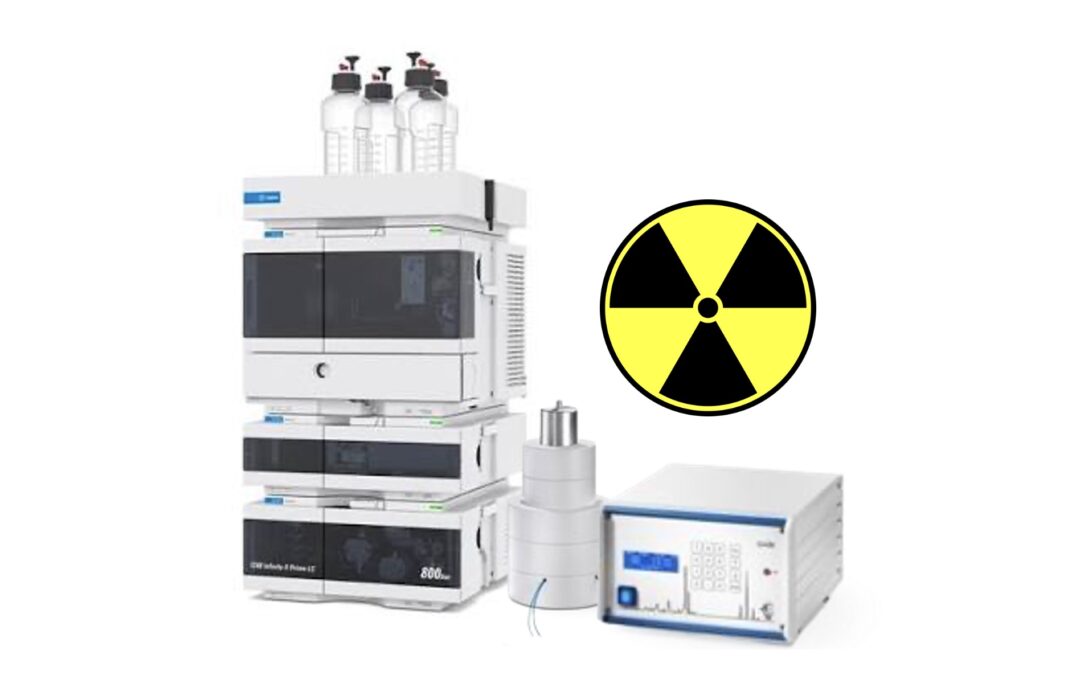
Radio-HPLC is a specialized analytical technique in radiopharmacy and radiochemistry and is used to determine radiochemical purity and its sideproducts. The radio-HPLC consists of a conventional HPLC with a radio detector attached. This is the method of choice for quality control of molecules containing a radionuclide. It differs from conventional HPLC in seven key ways. In this article, I will discuss the radio-HPLC basics and the seven differences to conventional HPLC.
Contents
- What Is Radio-HPLC? A Brief Definition
- 7 Key Differences Between Radio-HPLC and Conventional HPLC
- 1. The Time Factor: Radioactive Decay as a Time Limit
- 2. Detection: Radioactivity Instead of UV Absorption
- 3. Sample Preparation and Sample Volume: Nanograms Instead of Milligrams
- 4. Regulatory Framework: The Intersection of Multiple Regulatory Frameworks
- 5. System Qualification
- 6. Safety and Radiation Protection
- 7. Data Analysis
- Similarities: What Stays the Same?
- Conclusion: The radio-HPLC basics
- FAQ: Frequently Asked Questions about the Radio-HPLC basics
- Next Step
Anyone familiar with conventional HPLC will already be familiar with the radio-HPLC basics: separation column, mobile phase, and detector; however, there are significant differences. Analysis time plays a crucial role. In addition, there are other regulatory requirements, such as radiation protection.
Radio-HPLC is a distinct analytical discipline that requires specialized knowledge, specialized equipment, and a deep understanding of compounds and radioactive isotopes. I have created a video on this topic for the HPLC-Academy: What is Radio-HPLC Basics and use of Radio-HPLC
Let’s have a look at the 7 most important differences between radio-HPLC and conventional HPLC, starting with the radio-HPLC basics.
What is Radio-HPLC? A Brief Definition
Radio-HPLC (radioactivity-HPLC) is a variant of high-performance liquid chromatography (HPLC) used to analyze radioactive labeled compounds. It is primarily used in radiopharmacy to determine the radiochemical purity (RCP) of radioactive drug substances and molecules, as well as their impurities, such as those found in PET tracers or therapeutic radiopharmaceuticals.
Traditional HPLC detectors, such as DAD, UV, or fluorescence detectors, can only detect non-radioactive compounds. For this reason, a radio detector is needed and connected to measure the ionizing radiation from the sample. The most common types of radio detectors are:
- NaI(Tl) scintillation detectors (for gamma-emitters such as ¹⁸F, ⁶⁸Ga)
- BGO detectors (bismuth germanate, also for positron emitters)
- Plastic scintillators (for beta emitters)
- Liquid scintillators (for alpha emitters)
At a first glance, this sounds like a simple addition, but it isn’t. And this is exactly where the differences start.
7 Key Differences Between Radio-HPLC and Conventional HPLC
1. The Time Factor: Radioactive Decay as a Time Limit
The most fundamental difference is the radioactive decay of the radionuclide.
In conventional HPLC, you have time. You can optimize a method, inject multiple times, perform SSTs, and if you need more time, you can freeze the sample for the next day.
In radio-HPLC, you’re working against the clock, or rather, against the laws of physics. ¹⁸F has a half-life of only 110 minutes that means after 110 minutes only half of the activity is left. ⁶⁸Ga has a half-life of 68 minutes, and ¹¹C has a half-life of just 20 minutes. This means:
- The entire quality control process must be completed within a tight time frame
- Long method run times are not an option
- Methods must be robust and work on the first try
- Trial and error in radio-HPLC is not a viable development approach
What needs to be done? The basis of Radio-HPLC is a rapid method that does not sacrifice resolution or peak shape. Method development and validation are performed using non-radioactive reference substances (cold standards) before the method is run with a radioactive sample. Potential radiochemical degradation products, such as radiolysis or cleavage of the linker, are not taken into account, which complicates method development later on. For this purpose, a second analytical method, radio-TLC, is used later.
2. Detection: Radioactivity instead of UV Absorption
In conventional HPLC, the UV detector is the standard workhorse. It measures the absorption of UV light by the analytes.
In radio-HPLC, the radio detector takes the center stage. It measures the ionizing radiation emitted by the analytes. Often, both detectors are connected in series as seen in Figure 1:
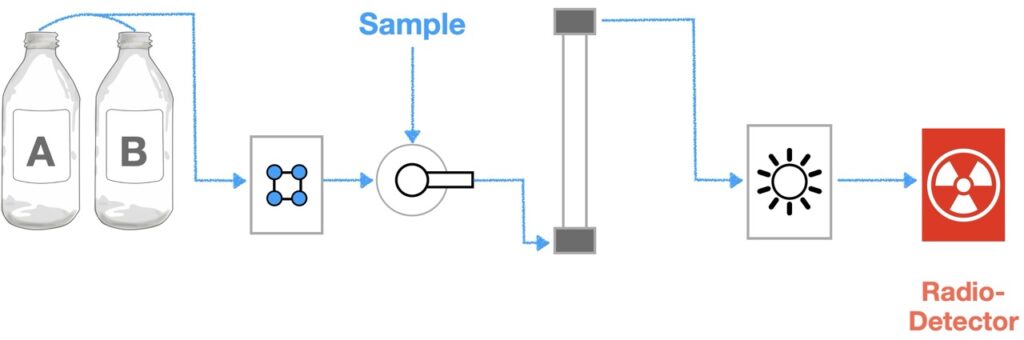
This configuration allows for the simultaneous (serial!) measurement of:
- UV signal: Total concentration of the compound (non-radioactive)
- Radioactivity signal: Only the radioactively labeled compounds
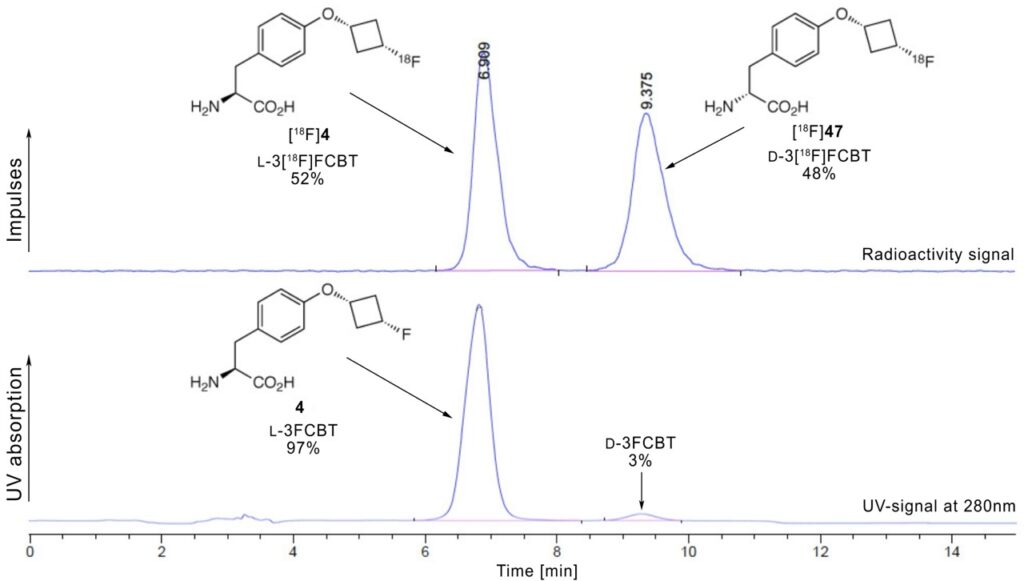
The UV detector provides information about the chemical composition, but it does not reveal anything about radiochemical compounds. For that, we need a radio detector. This detector shows you the radioactive composition of your sample. This yields in the radiochemical purity (RCP) and, in special cases, the specific activity. These are the key quality parameters for radioactive pharmaceuticals. A sample chromatrogram is shown in Figure 2.
Important for method adaptation: The radio detector has a significantly lower resolution than a UV detector. This affects the peak shape and requires adjusted integration and evaluation parameters. The method must therefore be perfectly developed in order to detect byproducts as well.
3. Sample Preparation and Sample Volume: Nanograms Instead of Milligrams
In conventional HPLC, we often work with sample quantities in the milligram range. Concentration and injection volume can be adjusted flexibly.
In radio-HPLC, the amount of substance is extremely small, often in the nanogram to microgram range. There are several reasons for this:
- Radioactive pharmaceuticals are produced in very small quantities (micro-tracing)
- High specific activities mean: low mass, high radioactivity
- Radiation protection limits the amount of activity that can be handled
This leads to analytical challenges that do not arise in conventional HPLC:
- UV signals are often below the limit of detection
- Radioactivity is the primary quantification parameter
- Carryover effects must be monitored with particular care, and the injection volume must be adjusted as necessary
4. Regulatory Framework: The Intersection of Multiple Regulatory Frameworks
This is the area that causes QC managers in radiopharmaceutical laboratories the most headaches—and rightly so.
Traditional HPLC validations primarily follow ICH Q2(R2) and the requirements of the respective pharmacopoeia (Ph. Eur., USP). The framework is clearly defined.
Radio-HPLC operates at the intersection of several regulatory frameworks simultaneously. Here are the documents relevant to the fundamentals of radio-HPLC:
| Regulatory Framework | Relevance to Radio-HPLC |
|---|---|
| Ph. Eur. 2.2.46 | Spezial for HPLC system |
| Ph. Eur. 2.2.66 | Radioactivity Measurement |
| Guide Pharmaceutical Preparations (Ph. Eur.) → PDF Download | Radiopharmaceutical preparations (see Radio-HPLC) |
| ICH Q2(R2) → PDF Download | General Validation Requirements |
| GMP Annex 3 | Manufacture of Radio pharmaceuticals |
| EMA Guidelines | Specific to PET pharmaceuticals |
| Radiation Protection Law | Country-specific (StrlSchG, StrSchV in Germany) |
| Germany: DIN 25425-1 | Structural Radiation Protection in Germany |
What needs to be done? Validations for radio-HPLC must take all relevant regulations into account. A validation based solely on ICH Q2 is generally not sufficient. Furthermore, it is not enough for only the HPLC to be qualified (see point 5 below). The radio detector must be included in the qualification. Important: The radio detector must be calibrated and qualified according to the radionuclide, as parameters such as linearity, response time, and detection limits (minimum and maximum) may vary.
5. System Qualification: The Radio Detector as a Critical Component
In conventional HPLC, system qualification (DQ, IQ, OQ, PQ) is well-established and well-documented. Qualification of the UV detector is routine.
In radio-HPLC, the radio detector is an additional critical component. Its qualification requires:
- Calibration of detection efficiency (energy-dependent, nuclide-specific)
- Verification of linearity in the relevant activity range
- Dead-time corrections (at high count rates)
- Background measurement and radiation protection documentation
- Regular recalibration (since detector characteristics may change)
Many laboratories underestimate the effort required to qualify a radiation detector and then face uncomfortable questions during audits.
6. Safety and Radiation Protection: An Integral Part of the Analytical Process
This is the most obvious difference, but it has far-reaching consequences for the analytical procedure.
In conventional HPLC, safety considerations are important (solvents, chemicals, toxic fumes), but they have little impact on the analytical process.
In radio-HPLC, radiation protection is an integral part of every step of the analysis:
- Sampling and injection are performed behind lead-glass shields using a lead-shielded syringe.
- HPLC systems are installed in special radiation protection cabinets or are shielded by lead blocks.
- Waste (contaminated solvents, consumables) is radioactive waste and must be shielded and disposed of appropriately.
- Contamination controls are part of the analytical protocol.
- Handling of consumables is complex because it takes place in the controlled area.
- An HPLC column cannot simply be reused in the cold lab, as it must be allowed to decay and monitored for radioactivity before it leaves the control area.
This means that methods must be developed in such a way as to minimize radiation exposure for staff—shorter run times, smaller injection volumes, and automated systems (autosamplers) whenever possible.
7. Data Analysis: Radiochemical Purity as the Primary Parameter
In conventional HPLC, purity is typically determined based on peak area ratios in the UV chromatogram.
In radio-HPLC, radiochemical purity (RCP) is the key quality parameter, and its calculation involves several unique considerations:
Calculation of RCP:
RCP (%) = (area of main peak in Radio chromatogram / Total area of all Radio peaks) × 100It sounds simple, but it’s not always that way, because:
- Decay Correction: For long measurement times and short half-lives, the decrease in activity due to radioactive decay must be corrected
- Background Correction: Ambient radiation affects the measurement signal
- Dead-time corrections: Since the UV and radiation detectors are connected in series, the difference in response time must be taken into account
- Note the radiation detector’s min-max limits: At high count rates, saturation effects occur in the detector; the same applies to the minimum activity.
- Peak Identification: Peaks may appear in the radiochromatogram that are not visible in the UV chromatogram (radioactive metabolites, impurities)
- Free radionuclides or highly polar radioactive compounds may not be detectable using C18 radio-HPLC or may skew the results. To verify the results, an additional method—radio-TLC—should be used (this is discussed in detail in the HPLC Academy).
Minimum regulatory requirement: Most radio pharmaceuticals require an RCP of ≥ 95% (Ph. Eur., product-specific monographs). Even stricter specifications apply to some PET tracers.
Similarities: What Stays the Same?
Despite all their differences, radio-HPLC and conventional HPLC share important fundamental principles:
- Chromatographic separation based on the same physicochemical principles (reverse phase, normal phase, ion exchange)
- System suitability tests (SST) before and during each analysis run
- GMP documentation requirements
- Validation parameters such as specificity, linearity, precision, trueness, and robustness (with adapted protocols)
What does that mean? Anyone who has a good command of conventional HPLC has a solid foundation for radio-HPLC. But this foundation must be expanded in a targeted manner.
Conclusion: The radio-HPLC basics require specialized knowledge
The differences between radio-HPLC and conventional HPLC are significant. They affect the entire analytical process: from method development and system qualification to regulatory documentation.
For QC managers and analysts in research, radiopharmaceutical laboratories, and CDMOs, this means that general HPLC knowledge is not sufficient. Anyone who wants to develop, validate, and apply radio-HPLC methods in a GMP environment needs specific, structured knowledge.
The good news is that this knowledge can be acquired if it is taught systematically.
FAQ: Frequently Asked Questions About the Radio-HPLC basics
What is Radio-HPLC, explained simply?
Radio-HPLC is a variant of high-performance liquid chromatography in which radioactively labeled compounds are analyzed. Instead of a UV detector—or in addition to one—a radio detector is used to measure the ionizing radiation emitted by the sample. It is primarily used in radiopharmacy to determine radiochemical purity (RCP).
What is the difference between radio-HPLC and conventional HPLC?
The most important difference is detection: While conventional HPLC primarily measures UV absorption, radio-HPLC measures the radioactivity of the sample. Added to this are the extreme time constraints due to radioactive decay, significantly smaller sample volumes, specific radiation protection requirements, and a more complex regulatory framework (Ph. Eur., GMP Annex 3).
What does radiochemical purity (RCP) mean?
Radiochemical purity indicates the percentage of the radioactive substance that is present in the desired chemical form. It is determined by HPLC and is the most important quality parameter for radioactive pharmaceuticals. Most radiopharmaceuticals require an RCP of ≥ 95% in accordance with the European Pharmacopoeia.
What regulations apply to radio-HPLC in radiopharmacy?
Radio-HPLC unterliegt mehreren Regelwerken gleichzeitig: Ph. Eur., ICH Q2(R2) (Validierung), GMP Annex 3 (Herstellung von Radiopharmaka) sowie dem nationalen Strahlenschutzrecht (in Deutschland: StrlSchG, StrSchV) und DIN 25425-1 für die Auslegung des Labors.
How do I learn the radio-HPLC basics?
With classic HPLC, you have a solid foundation. This article covers the radio-HPLC basics, and you’ll find an excellent knowledge base in the HPLC Academy modules on radio-HPLC that will help you deepen your understanding. I’m always available to answer any further questions you may have.
Can I adapt my conventional HPLC method directly for radio-HPLC?
Yes and no. However, the method must be adapted. Conventional HPLC methods are often too time-consuming for short-lived radionuclides and do not account for the specific characteristics of the radio-detector (such as resolution and dead-time corrections). Method development and validation must be carried out specifically for radio-HPLC. The HPLC systems located in controlled areas are often older and lack of an autosampler, necessitating further adjustments.
Practical tip: Develop and optimize and, if necessary, validate the method using non-radioactive samples; then transfer it to the radio-HPLC system and optimize the radiochemical parameters. Verify both HPLC systems (if they are not the same unit) using a non-radioactive (“cold”) standard. Any potentially lower detection limit of the UV detector in older units is of minor importance here, as very small quantities are used for radiolabeling in any case (see Difference 3: Sample preparation and sample quantity).
How long does a radio-HPLC analysis typically take?
Due to the short half-lives of the radionuclides used (e.g., ¹⁸F: 110 min, ⁶⁸Ga: 68 min), radio-HPLC methods must be designed for short run times, typically 5–15 minutes. The entire quality control process must be completed within a narrow time window.
I’ve read the article Radio-HPLC Basics. What can I do next?
Continue to deepen your knowledge of radio-HPLC at the HPLC Academy. There, you’ll find many free modules on HPLC and radio-HPLC basics, including plenty of videos, checklists, and guides. Just sign up.
Next Step: Free Radio-HPLC Mini-Course
Would you like to build your radio-HPLC knowledge in a structured way, from the basics to GMP-compliant validation?
In my free Radio-HPLC mini-course, you’ll learn:
✅ The systematic development of Radio-HPLC methods
✅ The regulatory requirements according to the European Pharmacopoeia and GMP Annex 3
✅ The most common errors in Radio-HPLC analyses and how to avoid them
✅ Bonus: The Radio-HPLC Guide (PDF)
Free. Available immediately. No spam.
👉 Get your free HPLC-Knowledge Database now →
(includes a free Radio-HPLC Guide)
About the Author
Dominic Franck is an HPLC specialist with over 15 years of experience in the pharmaceutical and radiopharmaceutical industries and the founder of the HPLC Academy. He learned the radio-HPLC basics over 11 years ago at the University of Cambridge and ETH Zurich, where he further developed his knowledge and wrote a paper on the subject. He served as head of the Analytics Department and has overseen numerous HPLC validations and audits. On his YouTube channel, he provides practical guidance on using HPLC and shares tips and tricks for troubleshooting. Through the HPLC Academy and the specialized Radio-HPLC module, he helps users, analysts, and QC managers develop, optimize, and validate their methods on the first try and pass audits with confidence.
YouTube | LinkedIn | HPLC-Academy
Last updated: August 2026