

The ICH Q2(R2) revision has been in effect as a mandatory requirement since June 14, 2024, replacing ICH Q2(R1) as the global standard for the validation of analytical methods in the pharmaceutical industry. For QC managers, analysts, and validation specialists in pharma, biotech, radiopharmaceuticals, and CDMOs, this means that all new validations must be conducted in accordance with ICH Q2(R2) and validation protocols must reference it; protocols citing Q2(R1) are formally obsolete. Existing protocols should be updated during the next revalidation cycle. Furthermore, the entire lifecycle of the analytical method is taken into account.
- What is ICH Q2(R2)?
- An ICH guideline covering validation parameters such as specificity, linearity, accuracy, precision, and robustness.
- Must be demonstrated prior to batch release.
- Recognized by the EMA and FDA.
- Establishes an explicit link to ICH Q14 for the first time (validation as part of an end-to-end analytical lifecycle).
- Who is affected?
- Anyone validating analytical methods in a GMP environment.
- QC managers, analysts.
- Validation personnel (QC, QA).
- CDMOs.
- Regulatory applicants in pharma, biotech, and radiopharmaceuticals.
- What has ICH Q2(R2) revision?
- Three key points
- Robustness shifted to method development (ICH Q14) rather than the validation study.
- Reportable range clearly defined (e.g., 80–120% for assay/content determination).
- System Suitability Testing (SST) is a central component.
What is truly relevant in practice for HPLC and radio-HPLC validations? This article provides a compact, practice-oriented overview.
Background: Why was the ICH Q2(R2) Revision introduced?
ICH Q2(R1), dating back to 2005, was designed for classical analytical methods such as UV spectroscopy, conventional HPLC, and titration. The analytical landscape has evolved significantly since then:
- Multivariate methods (NIR, Raman, PAT) have become established in routine analysis.
- Lifecycle concepts for analytical methods (continuous improvement rather than one-off validation) were introduced in ICH Q14.
- In practice, robustness was often misclassified—viewed as part of validation rather than development.
- Radiopharmaceuticals and biologicals required adapted approaches that were not addressed in Q2(R1).
ICH Q2(R2) closes these gaps and aligns the validation guideline with the modern pharmaceutical quality system (ICH Q8–Q14).
Overview of the key changes:
| Aspect | ICH Q2(R1) (until June 2024) | ICH Q2(R2) (since June 2024) |
|---|---|---|
| Document structure | Q2A + Q2B merged | A consolidated document |
| Link to development | Not explicitly | Explicitly linked to ICH Q14 |
| Robustness | Part of the formal validation study | Primarily during the development phase (prior to validation) |
| Reportable Range | Not clearly defined | Clearly defined, dedicated table for various applications |
| SST | Not clearly defined | New as an integral part with ICH Q14 |
| Multivariate methods | Unaddressed | Separate section (Chapter 2.5) |
| Combined accuracy/precision approach | Not planned | Explicitly permitted |
| Lifecycle approach | One-time validation | Validation as part of the analytical lifecycle |
| Platform method | Unaddressed | Shortened validation possible for established platform methods |
The 7 most important changes in detail
1. Robustness belongs in development, not in validation
This is the most practically significant change for many laboratories.
In ICH Q2(R1), robustness was an optional part of the validation study and was often performed as the final step—or sometimes omitted entirely.
In ICH Q2(R2), robustness is primarily a component of method development (linked to ICH Q14) and should be completed BEFORE the formal validation study. Results from the development phase can be used as validation data, provided they are documented.
Practical implication: Laboratories that previously assessed robustness during validation must now adjust their protocols. Development data must be accessible and capable of being referenced.
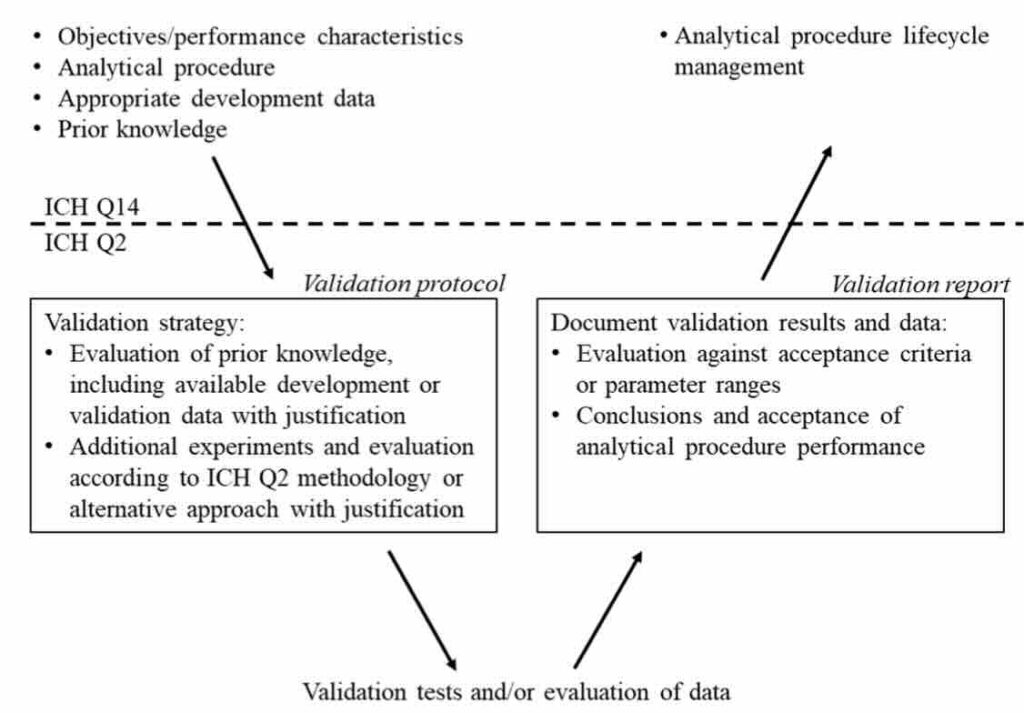
2. Link to ICH Q14: Validation as a lifecycle concept
ICH Q2(R2) is explicitly linked to ICH Q14 (Analytical Procedure Development). This means:
- Knowledge gained during method development (development data, DoE studies, robustness studies) can be used directly as validation data.
- Validation is no longer a one-time event but part of a continuous lifecycle.
- Changes to validated methods are evaluated within the context of the lifecycle using a risk- and science-based approach.
Practical consequence: Development data must be carefully documented and form part of the validation documentation.
3. Reportable Range: Now clearly defined
ICH Q2(R2) introduces the term “reportable range” and clearly defines it: the range within which the method yields results with acceptable response, accuracy, and precision.
Recommended reportable ranges for common applications:
| Application | Lower Limit | Upper Limit |
|---|---|---|
| Determination of content | 80% of declared content | 120% of declared content |
| Potency | Lower specification limit −20 % | Upper specification limit +20 % |
| Uniformity | 70 % of declared content | 130 % of declared content |
| Impurities | Reporting Threshold | 120 % of the specification limit |
4. SST as an integral component
With the joint introduction of ICH Q14 (analytical procedure development) and ICH Q2(R2), system suitability testing (SST) is no longer viewed in isolation. The criteria for SST are derived directly from the Analytical Target Profile (ATP) and the risk assessments conducted during method development.
5. Multivariate Methods: Separate Section
For the first time, ICH Q2(R2) addresses multivariate analytical methods (NIR, Raman, PAT, PLS models) in a dedicated chapter (2.5). While this is initially less relevant for conventional HPLC laboratories, the section is important for laboratories increasingly employing in-line analysis or spectroscopic methods.
6. Combined approach for accuracy and precision
ICH Q2(R2) explicitly permits a combined approach to determining accuracy and precision in a single study, rather than conducting two separate experiments. This reduces the validation effort, provided the study is properly designed.
7. Shortened validation for platform methods
If an established platform method is adapted for a new purpose, validation can be shortened, provided this is scientifically justified. This is particularly relevant for laboratories transferring standardized HPLC methods to a new product.
What does this mean specifically for your validation protocol?
Immediate measures (for new protocols):
- Update reference: ICH Q2(R1) → ICH Q2(R2) (EMA/CHMP/ICH/82072/2006, effective from 14 June 2024)
- Reclassify robustness: Document as development data, not as a validation step
- Define the reportable range and explicitly state it in the protocol
- Establish a link to ICH Q14 and reference development data
For existing protocols (at the next revalidation):
- Replace the reference to Q2(R1) with Q2(R2)
- Transfer robustness data from development to the validation file
- Explicitly define the reportable range, if not already done
What changes specifically regarding radio-HPLC validation?
For radio-HPLC validation in radiopharmacy, the changes introduced by ICH Q2(R2) are manageable; the fundamental radiopharmacy-specific adjustments, recovery instead of accuracy, repeatability instead of reproducibility, and activity-based linearity, remain unchanged and continue to be governed by the EANM guideline (Gillings et al. 2020).
The most important change for radio-HPLC is that robustness data must now be available as part of the development data, rather than as a retrospective validation step.
👉 Full details on radio-HPLC validation according to ICH Q2(R2), EANM, and GMP Annex 3: Radio-HPLC Validation: Step-by-Step →
FAQ: ICH Q2(R2)
When does ICH Q2(R2) become mandatory?
ICH Q2(R2) has been in effect since June 14, 2024. New validation protocols must reference Q2(R2). Existing validated methods do not need to be revalidated immediately, but the transition should be made at the time of the next revalidation or significant method change.
Do I need to update my existing validation protocols immediately?
No, immediate revalidation of all existing methods is not required. The transition from Q2(R1) to Q2(R2) takes place within the scope of the normal method lifecycle. However, a switch to Q2(R2) should be made in the event of significant method changes or planned revalidations.
What are the changes in ICH Q2(R2)?
ICH Q2(R2) describes the validation of analytical methods. ICH Q2(R1) is no longer valid. The link to ICH Q14 is important; the analytical method is viewed as a whole, spanning development, validation, and lifecycle management.
What is ICH Q14?
ICH Q14 describes the development of analytical methods. The ICH Q2(R2) and ICH Q14 guidelines are explicitly linked: development data from ICH Q14 can be used as validation data for ICH Q2(R2).
Does ICH Q2(R2) also apply to radiopharmaceuticals?
Yes! ICH Q2(R2) serves as a foundational guideline. For radiopharmaceuticals, it is supplemented by the EANM guideline (Gillings et al. 2020), which outlines radiopharmacy-specific adjustments to validation parameters.
Which validation parameters have changed in terms of content?
The core parameters (specificity, linearity, accuracy, precision, LOD, LOQ, robustness) have remained largely unchanged in substance. The most significant change regarding content is the reclassification of robustness into the development phase and the explicit definition of the “reportable range“.
Sources
- ICH Q2(R2): Guideline on validation of analytical procedures.EMA/CHMP/ICH/82072/2006. valid since June 14, 2024.
- ICH Q14: Analytical Procedure Development. EMA/CHMP/ICH/531628/2021.
- Gillings N. et al. (2020): EANM guideline on the validation of analytical methods for radiopharmaceuticals. EJNMMI Radiopharmacy and Chemistry 5:7. DOI: 10.1186/s41181-019-0086-z
Next Steps: Build up HPLC knowledge in a structured way
Do you want to learn more about HPLC validation in your laboratory and implement audit-ready radio-HPLC validations in accordance with ICH Q2(R2), EANM guidelines, and GMP Annex 3?
In the free HPLC-Academy HPLC-knowledge base, which includes HPLC validation, you will learn:
✅ Systematic setup of radio-HPLC detectors
✅ Self-paced learning with numerous videos, instructions, checklists, and practical examples
✅ Practical explanation of validation requirements according to Ph. Eur., ICH Q2(R2), and GMP Annex 3
✅ Common validation errors and how to avoid them from the start
✅ Bonus: Free HPLC Detector Guide (PDF)
Free. Available immediately. No Spam.
👉 Get free access to the knowledge base now →
(includes a free Radio-HPLC Guide)
Or perhaps you would like to have your existing radio-HPLC methods and validation documents evaluated by an expert?
👉 Request HPLC-Validation Audit →
About the Author
Dominic Franck is an HPLC specialist with over 15 years of experience in the pharmaceutical and radiopharmaceutical industries and the founder of the HPLC Academy. He learned the radio-HPLC basics over 11 years ago at the University of Cambridge and ETH Zurich, where he further developed his knowledge and wrote a paper on the subject. He served as head of the Analytics Department and has overseen numerous HPLC validations and audits. On his YouTube channel, he provides practical guidance on using HPLC and shares tips and tricks for troubleshooting. Through the HPLC Academy and the specialized Radio-HPLC module, he helps users, analysts, and QC managers develop, optimize, and validate their methods on the first try and pass audits with confidence.
Many videos on the topic: HPLC validation: YouTube
Connect with me: LinkedIn
Free HPLC knowledge base: HPLC-Academy
Last updated: September 2026