
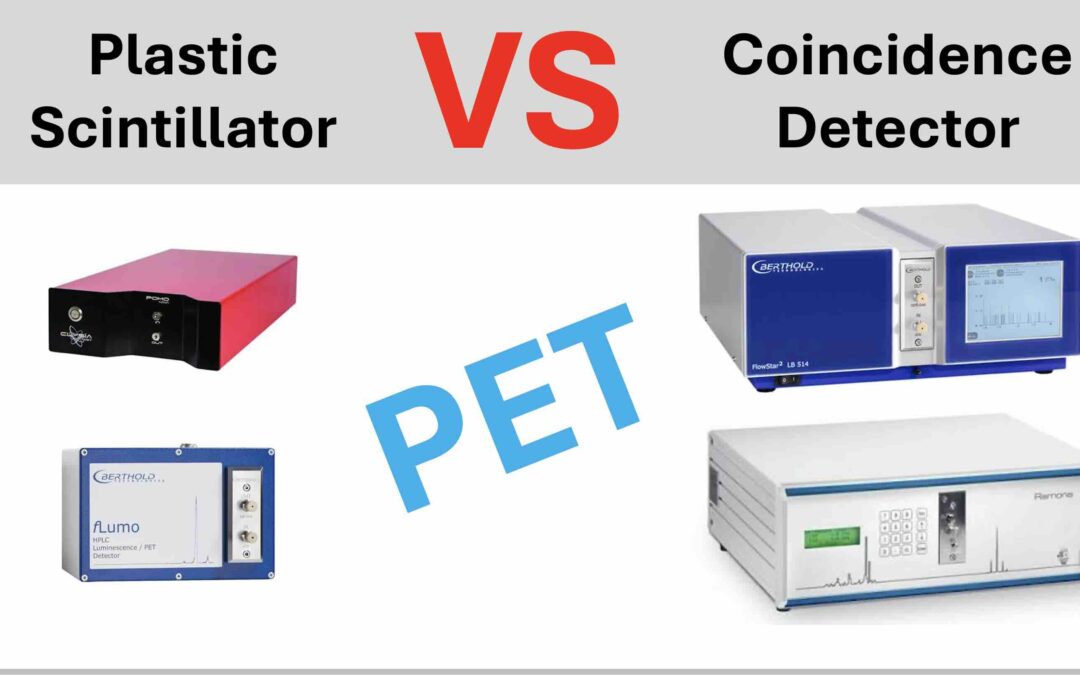
Coincidence detectors and plastic scintillator detectors are two types of radio-HPLC detector for PET; they differ significantly in terms of their operating principle, sensitivity, space requirements, and cost. Both types are suitable exclusively for PET isotopes. A plastic scintillator detector measures beta particles directly, whereas a coincidence detector relies on the detection of two opposing 511 keV photons, produced via annihilation as its signal. Plastic scintillator detectors are well-suited for routine PET quality control due to their ease of use, low acquisition costs, and the fact that they do not require periodic calibration. Coincidence detectors, by contrast, offer an exceptionally low limit of detection, making them ideal for metabolite determination and for analyses conducted after a long decay period.
Contents
When setting up or modernizing a PET center, one must decide which radio-detector to use for radio-HPLC. I have faced this decision myself. Which is better: a coincidence detector or a plastic scintillator? Both types are suitable for PET isotopes, but they differ significantly in terms of sensitivity, operational requirements, space, and cost. Choosing the wrong one leads either to unnecessary complexity or to a method that reaches its limits when dealing with low levels of radioactivity.
Background: Why both detectors work for PET
PET isotopes (¹⁸F, ¹¹C, ⁶⁸Ga, ¹³N, ⁸⁹Zr, etc.) decay via positron emission (β⁺). The emitted positron immediately annihilates with an electron from the surrounding material, producing two 511 keV gamma photons that are emitted simultaneously in exactly opposite directions, as shown in Figure 1.
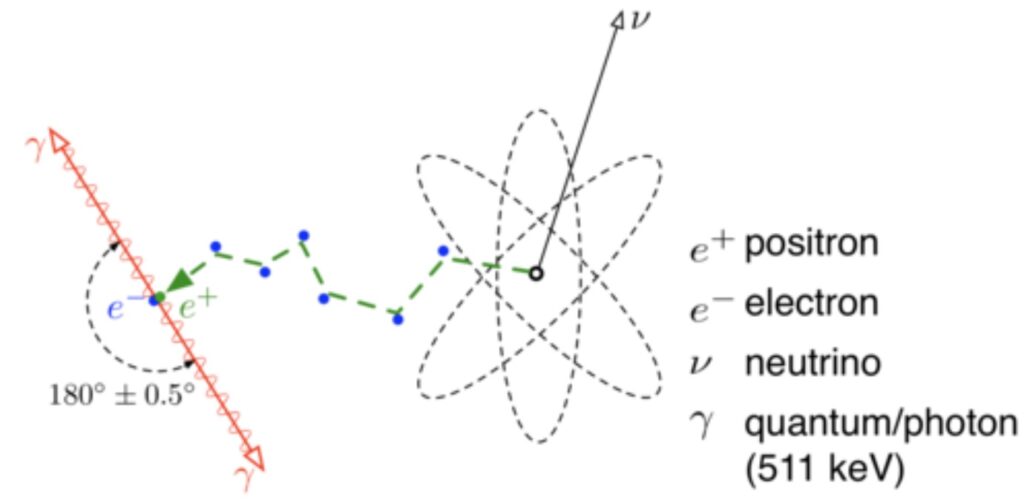
This physical mechanism annihilation serves as the basis for both types of detectors:
- The plastic scintillator detects the positrons directly, before they annihilate (or it detects the resulting 511 keV photons via Compton scattering).
- The coincidence detector uses the two opposing 511 keV photons as a signature for detection.
The plastic scintillator/PMT is primarily suited for beta and positron emitters and, under appropriate measurement conditions, can also detect the beta signal from ¹⁷⁷Lu. In contrast, the coincidence detector is specifically designed for positron emitters, as it detects the two 511 keV annihilation photons in coincidence. For pure gamma emitters such as ⁹⁹ᵐTc and ¹²³I, as well as for the detection of gamma radiation from ¹⁷⁷Lu, a suitable gamma detector, for example, NaI(Tl), is required.
The plastic scintillator beta detector
Operating Principle
A plastic scintillator is an organic polymer that emits flashes of light when it interacts with ionizing radiation. The HPLC flow cell is in direct contact with the scintillator material. Beta particles from PET isotopes have a short range; they deposit all of their energy within the plastic scintillator.
Since gamma photons from the surrounding environment typically pass through the plastic scintillator without interacting, the background level remains very low, even without the need for elaborate lead shielding.
Strengths
- Compact and lightweight: No lead, no heavy housing, easy integration into existing HPLC systems
- No periodic calibration required; reduced qualification effort
- Low background due to minimal gamma interaction with the plastic scintillator
- Simple operation: Few parameters, robust performance
- Lower acquisition costs compared to a coincidence detector
Limitations
- LOQ typically in the range of 500–2,000 Bq, depending on cell volume and flow rate [Gillings 2020]
- Not suitable for very low activities (late measurement time points, diluted plasma samples)
- No energy discrimination: All beta events are counted; no possibility for isotope identification via energy windows
- Not suitable for SPECT isotopes, ¹⁷⁷Lu, or therapeutic radionuclides
Typical application
Standard QC analysis of PET radiopharmaceuticals: ¹⁸F-FDG, ¹⁸F-PSMA, ⁶⁸Ga-PSMA, ⁶⁸Ga-DOTATOC, ¹¹C-choline. The activity levels during release testing typically range from several kBq to MBq—well above the limit of quantitation (LOQ) of the plastic scintillator.
The Coincidence Detector
Operating Principle
A coincidence detector consists of two scintillation crystals (BGO) positioned 180° opposite each other, with the HPLC flow cell located between them. Each crystal (mostly BGO) is coupled to a photomultiplier tube (PMT) or a silicon photomultiplier (SiPM).
A signal is registered only if both crystals respond simultaneously within a very narrow time window (typically 5–20 nanoseconds). This coincidence window corresponds precisely to the physical mechanism of PET annihilation: both 511 keV photons strike the opposing crystals almost simultaneously.
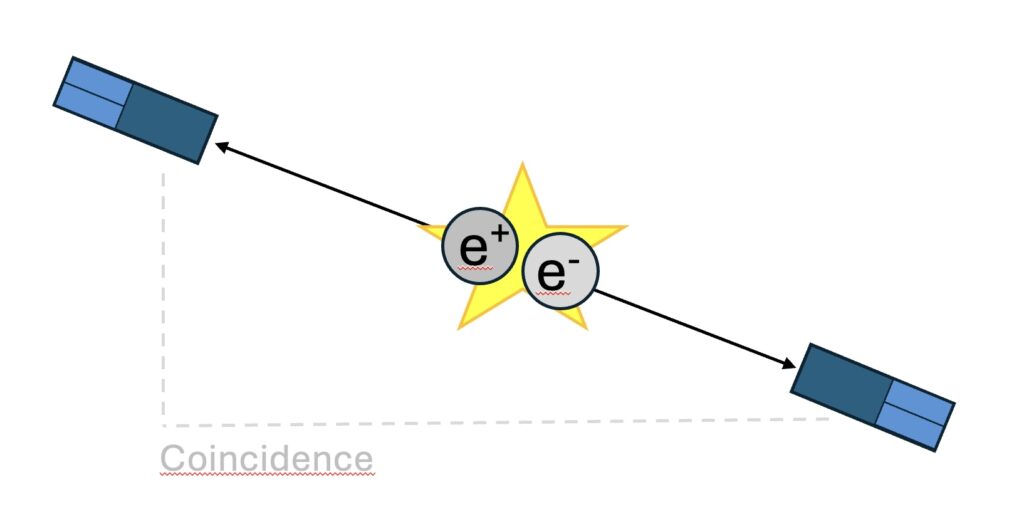
Background gamma photons from the surroundings have an extremely low probability of striking both crystals simultaneously, and thus do not generate a signal.
Strengths
- Dramatically reduced background due to coincidence requirement
- LOQ (limit of quantification) below 100 Bq achievable—up to an order of magnitude better than plastic scintillators
- Ideal for metabolite analysis in plasma samples with very low activity concentrations
- Ideal for measurements taken at late time points, after several half-lives
- Requires less shielding than NaI(Tl), but more than plastic scintillators
Limitations
- Higher initial cost compared to plastic scintillators
- More complex electronics (coincidence logic, time-window settings)
- Limited exclusively to PET isotopes; no flexibility for SPECT or therapeutic isotopes
- Requires more space than plastic scintillators
Typical application
- Metabolite analysis in plasma for ¹⁸F and ¹¹C
- Quality control at very low activity levels (e.g., after a long decay period)
- Research applications with stringent requirements for detection limits
- Preferred for rapid measurement in combination with U(H)PLC [Franck 2009]
Direct comparison: coincidence detector vs. plastic scintillator
| Criterion | Plastik scintillator | Coincidence Detektor |
|---|---|---|
| Detection | Primarily beta and positron emitters | Specifically for positron emitters, since both 511 keV annihilation photons are detected in coincidence |
| Isotope1 | PET (¹⁸F, ¹¹C, ⁶⁸Ga) also high beta-Emitters such as 177Lu, 131I (POMO Nova) | PET (¹⁸F, ¹¹C, ⁶⁸Ga) also for Gamma, 125I, 35S, 33P etc. with special flow cell2 |
| LOQ (typical) | 500-4.000 Bq [Thonon 2013] | < 100 Bq |
| Background | Low | very low |
| Shielding | Minimal | Low (less than with NaI/BGO) |
| Calibration | None | Time-window calibration (Energy window calibration with falls NaI/BGO) |
| Complexity | Simple | Medium |
| Space requirements | Klein | Medium |
| Cost | Lower | Hihger |
| Metabolite analysis | Limited | ✅ Optimal |
| Routine QC | ✅ Optimal | Possible, but over-dimensioned |
1 Depending on the scintillator or the installed detector cell
2 Consultation regarding the appropriate cell is available upon request from the manufacturer,
A liquid scintillator and a pump may be required.
Which detector, when?
Plastic scintillator: the right choice if:
- The laboratory performs only standard PET QC (release of ¹⁸F-FDG, ⁶⁸Ga-PSMA, etc.)
- Activity levels during measurement are above 1 kBq
- Simplicity, compactness, and low maintenance requirements are priorities
- The budget is limited and no metabolite analyses are planned
Coincidence detector: the right choice if:
- Metabolite analyses are performed in plasma or other bodily fluids
- Measurements at very low activity levels (< 500 Bq) are required
- Measurements need to be taken at late time points, after several half-lives
- The highest level of methodological sensitivity is required (e.g., in research laboratories)
- There is a need for rapid measurement, such as in U(H)PLC applications
Can both be combined?
Yes, some systems allow for switching between plastic scintillator mode and coincidence mode using the same hardware. This provides maximum flexibility: routine QC in plastic scintillator mode, and metabolite analyses in coincidence mode.
However, if your laboratory performs only standard QC, this flexibility is rarely needed in practice and does not justify the additional cost.
Conclusion: Radio-HPLC detector for PET
Coincidence detectors and plastic scintillator-based radio-HPLC detectors can both be used for PET isotopes. Depending on the detector cell employed, a coincidence detector can also be used for other radioisotopes. The primary differences lie in their functionality, operational requirements, and costs. The plastic scintillator detector is a cost-effective solution for routine quality control (QC), offering low background levels and ease of use. The coincidence detector is suitable for metabolite analysis and the detection of very low levels of radioactivity, though it entails a higher initial investment. Coincidence detectors are the preferred choice for U(H)PLC applications characterized by rapid run times. Neither type is suitable for SPECT or ¹⁷⁷Lu; for these applications, a NaI(Tl) detector is required.
If you have any further questions about the Radio-HPLC detector for PET,
👉 Contact me with no obligation →
FAQ: Frequently Asked Questions
Is the coincidence detector always better than the plastic scintillator?
No, it is more sensitive, but not universally better. For standard PET quality control (QC) involving activities in the kBq range, the plastic scintillator is perfectly adequate and significantly easier to operate. The coincidence detector is superior when very low activities (< 500 Bq) need to be quantified.
Can both detectors be used for ¹⁷⁷Lu?
No. ¹⁷⁷Lu is a pure beta emitter with gamma co-emission; it is not a PET isotope. Neither a plastic scintillator nor a coincidence detector is suitable for ¹⁷⁷Lu. Instead, an NaI(Tl) gamma detector is required to detect the characteristic 208 keV gamma photons of ¹⁷⁷Lu.
What does LOQ < 100 Bq mean in practice?
An LOQ of 100 Bq means that peaks with a radioactivity of 100 Bq can still be reliably quantified. In practice, this is relevant for metabolite analyses in plasma samples, where the activity concentration can be very low following dilution and radioactive decay. For standard QC release testing, an LOQ of 1,000 Bq is generally sufficient.
Do I need lead shielding for the plastic scintillator?
No, that is one of the key advantages. Beta particles are stopped by the detector material itself. Ambient gamma radiation hardly interacts with the plastic scintillator. A thin housing shield is generally sufficient.
Which manufacturers offer coincidence detectors for radio-HPLC?
Well-known providers include LabLogic (Beta-RAM with coincidence option), Berthold Technologies (FlowStar²), and Elysia-Raytest. The exact configurations and available measurement modes vary by model; I am happy to help you to find the best detector for your application – I am independent of any manufacturer. → Contact me
Sources
- Wikipedia, By Jens Maus, Public Domain, https://commons.wikimedia.org/w/index.php?curid=379922
- N. Gillings et al. (2020): EANM guideline on the validation of analytical methods for radiopharmaceuticals. EINMMI Radiopharmacy and Chemistry. DOI: 10.1186/s41181-019-0086-z
- European Pharmacopoeia (Ph. Eur.) Chapter 2.2.66: Detection and Measurement of Radioactivity
- D. Franck. et al. (2009): Faster analysis of radiopharmaceuticals using ultra performance liquid chromatography (UPLC®) in combination with low volume radio flow cell, Applied Radiation and Isotopes. DOI: 10.1016/j.apradiso.2009.02.077
- D. Thonon et al. (2013): Evaluation of an unshielded luminescence flow-through radio-HPLC detector for LC quality control and preparation of PET radiopharmaceuticals. Applied Radiation and Isotopes. DOI: 10.1016/j.apradiso.2012.10.015
- Berthold Koinzidenzdetektoren Datenblatt: FlowStar² LB 514 Brochure
- Elysia-Raytest Koinzidenzdetektoren Datenblatt: Ramona Star
- Elysia-Raytest Datenblatt: POMO Nova
About the Author

Dominic Franck is an HPLC specialist with over 15 years of experience in the pharmaceutical and radiopharmaceutical industries and the founder of the HPLC Academy. He learned the radio-HPLC basics over 11 years ago at the University of Cambridge and ETH Zurich, where he further developed his knowledge and wrote a paper on the subject. He served as head of the Analytics Department and has overseen numerous HPLC validations and audits. On his YouTube channel, he provides practical guidance on using HPLC and shares tips and tricks for troubleshooting. Through the HPLC Academy and the specialized Radio-HPLC module, he helps users, analysts, and QC managers develop, optimize, and validate their methods on the first try and pass audits with confidence.
Many videos on the topic: Radio-HPLC detectors (German): YouTube
Connect with me: LinkedIn
Free HPLC knowledge base: HPLC-Academy
Last updated: October 2026